Tuesday, August 5, 2025
School starts here today. Our granddaughters go back to South Knox today… a 7th grader, a 5th grader, and one in kindergarten. What happened to summer? I guess is just goes by too fast.
We’ve had a break from some pretty strong heat and humidity, but it sounds like it is returning by the weekend, with humidity indices near 100ºF.
Yesterday brought a big rain, as much as 3.5″ (89mm)! My work mowing roadsides and ditch levees will be put on hold until the ground firms back up. Brandon D will be delivering some wheat to market in Evansville. John has the spraying ‘caught up’ for now, and he will be looking for ways to minimize the use and expense of it for the remainder of the crop season. We do know that another trip of herbicide will be needed over the DCB, and perhaps a few spots in other fields, but at this time of year, we are trying to put that behind us.
After the big rain, we had a special sunset.

Monday evening.

This one was pretty nice, too, on Sunday evening.
Off to ADM in Evansville...we always appreciate the way Brandon D operates our trucks and equipment with great care…
Loading again for tomorrow
I have been working on the crop plan for 2026. It is rather hard to know now what the ideal allocation of acres to corn, soybeans, and wheat will be, until we have a clearer picture of the costs associated with each crop. The commodity prices are in a comparatively low place now and for next year, and those cost numbers are the biggest factor to consider. With current information, it is leading us to an increase of wheat/DCB acres for 2026. There are agronomic reasons we cannot move entirely to any one crop, and those are also factors we deliberate in the decision matrix. As we move through this month into September, some of those economic cost numbers will become better known, and we will adjust our acre plans. But we have to have a ‘starting point’, and that is where we are at this time. Always, we must be mindful of the present conditions and have a view of the discernable future at the same moment!
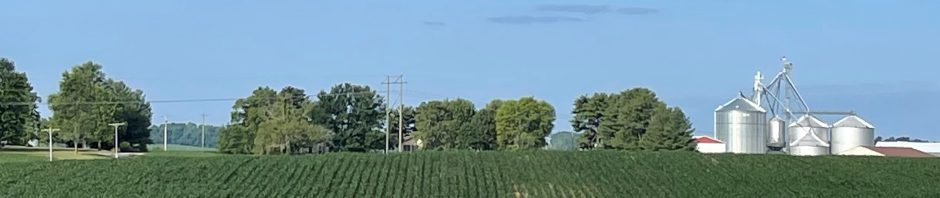
The double-crop soybeans (DCB) are now turning the wheat stubble fields back from gold to green. Most have grown above the stubble and are looking pretty healthy. It takes a bit over a month usually for this transition. And this summer is no exception. Is it a perfect stand of beans? No. That’s hard to achieve when we use an air drill to plant them, and we do not bale up the straw after wheat harvest. But I think these DCB look pretty good, and the prospects for a good harvest are favorable.

If you look out from our back yard, this is what you’ll currently see. The golden straw is disappearing beneath a carpet of green soybeans.
There was a little fog in the area to start the day. That brings up an old saying, “The number of fogs in August equals the number of snows in January”. It generally holds true, and I think we have just predicted the first snow!
Soon, the combines and trucks and tractors will come into the shop one by one to be prepared for fall harvest. They did not get extremely dirty during wheat harvest, but a good wash will make them shine like new. Each truck and trailer will be inspected and serviced. The combines will get the wheat harvest components removed from the threshing system, and the headers will be lubricated, the height and steering components will be adjusted, and all will be made ready! We hope the days are cooler when we are doing that shop work!
The Indiana State Fair is happening now in Indianapolis. Are you going?