Prescription Writing 101

Thursday, March 14, 2013

This morning Brandon and I sat at the office computer to write soybean planting prescriptions.  As we began, I explained the agronomics behind the variable-rate planting concept.  You can find this information in the post for March 4, 2013 called “Prescriptions”.

We opened the Apex software, and then a soil map for the Shake farm…a location which will be planted to soybeans in 2013.  We began with a click on the ‘create’ button, and then we navigated the several steps to assign a planting rate to each soil type.  The new prescription map then is commanded to display in 3 colors– red, yellow, and green– corresponding to the areas where a low, medium, or high population is assigned.

Low=140,000 seeds/acre— Med=170,000 seeds/acre—High=190,000 seeds/ac

Soon, he was ready to click ‘save’ on the first prescription.  But, there are many more to create!   We have 4 varieties of soybeans this spring, so each field will require 4 prescriptions written for each!  It can get a little tedious and repetitious, but he’s pretty dedicated.  Brandon can complete this process as it fits into his school schedule over the next several days.

Here, Brandon is taking a soil map of the Cox farm and using it to create a new soybean planting prescription.  Young people take on new technology pretty quickly!

Here, Brandon is taking a soil map of the Cox farm and using it to create a new soybean planting prescription.   The “Joseph’s coat” color scheme showing the different soil types will become a red, yellow, green prescription map.

Brandon caught on to the system pretty quickly, and I’m happy to be sharing this task with him.  It will be helpful to have another person equipped to take care of this kind of information technology.

It is sunny and more pleasant outside today.  45°F and the wind is low.  We had many times of off-and-on snow flurries yesterday, and there was a blustery wind making outdoor work unpleasant.  Ross missed all that, and I don’t think he’s sad about it.  But he says his Florida days are winding down and he’ll be “back home again in Indiana” before long.

If you look at your calendar, you’ll see that spring arrives in 1 week!  Oh, the thought!  If the rain holds off, we will likely begin to apply some NH3 next week.

Posted in Farm Days, News, Planting | Tagged , , , , | Leave a comment

New soybean planter arrives

Tuesday, March 12, 2013

The new soybean planter-air drill arrived last week.  It has impressed me with its size.  This new one has a lot more iron in it.  The old drill weighed in at about 19000 pounds, but this one, if I read the specs right, weighs 35,000 pounds!  It certainly looks heavier.  The main frame’s tires are beefier, too, to carry the additional weight.  This one’s 50-foot working width folds in 5 sections, compared to three on the old 40-foot drill.  We had it unfolded once after it arrived, but I failed to snap a picture of it in operating position.  I’ll capture that image the next time we hook it to the tractor, and share that picture with you.

The 60 rows are spaced 10 inches apart… which is a little different from other planting systems used in SW Indiana.  Most are 15-inches, some are 7.5 inches.  I think the row spacing is an ideal balance of seed costs, planter cost, and agronomic considerations like crop shading of the area between the rows.

My goal for this wider working width is that I can slow down a tiny bit during planting, to gain some precision with seed placement into the soil.  Probably I’ll drive 5.5 to 5.8 mph, rather than 6.2.

Here is the new 1890 no-till air drill.  It has 60 rows in its 50-foot working width.  You can see it folds down to about 19 feet for transporting.

Here is the new John Deere model 1890 no-till air drill. It has 60 rows in its 50-foot working width. You can see it folds down to about 19 feet for transporting.

The new air cart, a JD 1910, is very similar to the one traded in… having a 350-bushel seed capacity.  This size allows me to fill up in the morning, and plant all day without needing any re-fills.  This will allow me to plant, depending on seed size, anywhere from 240 to 360 acres… and for me that’s a pretty good day.   This frees up other people to assist in support of the corn planter or any other operation that needs to be occurring on the same day.

This is the part of the air drill system that carries the seed, and meters it and delivers it to the planting it pulls behind.  The conveyor attached to the near side is the device that loads the seed tanks.  There is a hydraulically-driven fan that moves the seed as it is precisely metered out of the tanks to each of the 60 rows on the drill.  Any blockage of the air system is instantly reported to the operator in the cab.  And the meters are set up in such a way as to change seeding rates on-the-go to match the planting prescription.  There are many simutaneous actions occuring when this machine is operating!

This is the new John Deere model 1910 air cart–the part of the air drill system that carries the seed, meters it, and delivers it to the planting implement it pulls behind. The conveyor attached to the near side is the device that loads the seed tanks. There is a hydraulically-driven fan that moves the seed as it is precisely metered out of the tanks to each of the 60 rows on the drill. Any blockage of the air system is instantly reported to the operator in the cab. And the meters are set up in such a way as to change seeding rates on-the-go to match the planting prescription. There are many simutaneous actions occuring when this machine is operating!

After viewing the assembly process in Valley City, North Dakota several days ago, I can appreciate the craftsmanship in this new machine even more.  We got to know some of the many people who designed and built our new air drill.

Posted in Farm Days, News, Planting | Tagged , , , , , | Leave a comment

Sunny day

Friday, March 8, 2013

I could not stand driving a dirty pickup any longer, so Brandon helped me wash the F-150 this morning.   Sure looks better.  I know they’re predicting rain on Sunday, but I’ll feel better about driving a clean pickup until then.

Don't know how long this wash job will last, but it looks good at the moment.  The sunny skies are very welcome today.

Don’t know how long this wash job will last, but it looks good at the moment. The sunny skies are very welcome today.

I’ll just have to drive very carefully in and out our lane… it’s pretty pathetic and needs new crushed stone in the worst way.  Probably by the end of the month, we can assume the freezing and thawing will be over… then it will feel good to put down new rocks.  Those potholes are really deep!  Hopefully, we’ll have the lane looking good before Ross and Rhoda return from Florida.

High school boys basketball ‘regionals’ will be played tomorrow.  This is the second tier of Indiana tournament play.  Sadly, our school is not playing tomorrow, but it’s a great time of year.  Indiana is, after all, the original home of March Madness.  We will be paying close attention to who gets to advance.

Have a good weekend.

Posted in Farm Days, News | Tagged , , , , , , , | Leave a comment

Hangin’ on

Tuesday, March 5, 2013

Winter just won’t go away.  What started as a light rain at 1230pm, is now at 3pm a heavy, wet snow.  The ground is white.   We don’t expect more than a couple inches of accumulation, but this winter  just keeps hanging on.

This afternoon, the snow is coming down heavy and wet.  There won't be any drifting... it's too sticky.

This afternoon, the snow is coming down heavy and wet. There won’t be any drifting… it’s too sticky.

Posted in Farm Days, News | Tagged , | Leave a comment

Special visitors

This afternoon, we had special visitors to the farm.  Our friends, Don and Ginny Patton from Evansville, Indiana brought their niece and her son for a farm visit.  Elizabeth and Franklin Roy are visiting from Boston, and Don wanted them to see the farm.  We welcomed them, and John gave them a short tour through the buildings, mostly to see the farm equipment.  They also wanted to see Ross’ horses, and barn-guy Matt showed them around.  I think the size of the machines was surprising to Elizabeth.  Son Franklin, 3-years-old, was quiet at first, but soon warmed to John’s attention.  He was like a little grown-up, and spoke very well.

Our guests today were, L to R, Elizabeth and Franklin Roy, Ginny and Don Patton.  It was a pleasure to share our afternoon with them.

Our guests today were, L to R, Elizabeth and Franklin Roy, Ginny and Don Patton. It was a pleasure to share our afternoon with them.

It is always a treat for us to host guests here, to share with them a little bit about what we do and how we do it.  Hopefully, our love for our farm life and livelihood comes across, too.   We are hopeful that the Roys will return to our farm when things are more active, and they can see some machines at work, rather than just in storage.  Thanks, Don and Ginny for bringing some family members to see us.

Posted in Farm Days, News | Tagged , , | Leave a comment

Prescriptions

Monday, March 4, 2013

I’ll be calling our Monsanto seed dealer, neighbor Jeff Jackson to learn if he has some seed sizes for our soybean seed.  We need to know that particular number, the seeds per pound, in order to write the planting prescriptions.  That number is different for each variety.  The soybean planter regulates the planting rates by measuring pounds of seed per acre… therefore, we must know how many seeds are in each pound in order to reach our target planting population…which is based on seeds per acre.  An average rate for us is 170,000 bean seeds per acre.

Determining the planting population for soybeans is counter-intuitive.  On better or more productive soils, we actually decrease the population, and for thinner or less productive soils, the rate is increased.  Using this variable-rate, soil-specific planting technique, it has allowed us to decrease our overall seed costs per acre by 10%– compared to planting a single-rate population across all acres.  With our soybean seed costs over $55/acre, such a system provides significant savings!

Brandon will assist me in writing the prescriptions this spring, and in so doing, he will learn the ‘how’ and ‘why’ of matching planting populations to soil types.  Upon examining a soil survey, we learn the productivity potential of each soil type…. and in our fields, we have from one to nine different soil types– most have 4 or 5.  From our experience, we can assign a planting rate to each soil type, typically in a low, medium, or high population rate.  In the John Deere Apex information management program, we build a prescription map, overlaying the appropriate population number on each soil type in the map.  This creates a new prescription map that shows the low, medium, and high rates.

This is a map of the soil types for a fleld here at the home farm.  You can see how many different types exist in just one field.

This is a map of the soil types for a fleld here at the home farm.  You can see how many different soils exist in just one field–this one has 9!

Here is a planting prescription designed for this same fleld.  Notice the red, yellow, and green colors correspond to low, medium, and high population rates.

Here is a planting prescription designed for this same fleld. Notice the red, yellow, and green colors correspond to low, medium, and high population rates.

Subsequently, as the soybean planter passes over the field, the GPS system reads the prescription map and automatically adjusts the planting rate of the seed to match the productivity potential of the soil.  And all the while, saving us 10% of overall seed costs!

Writing a prescription for each soybean variety for each field becomes a bit tedious or cumbersome, but the results are beneficial.  It’s so worth the effort.

In meeting with the Operations Manager at the John Deere Seeding Group in Valley City, ND during our tour last week, I requested the following improvements to their system.  1.  A seed metering system that actually counts the seeds/acre rather than calibrated on pounds/acre.  This would allow me to write one master prescription for each field, and it would probably be good for multi-year use.  2.  A section-control system on the metering system so that overlapping planting would not occur when in point-row situations.  They tell me these are under development!  Maybe by the time I order the next drill in 3-4 years, these features will be available.

Congratulations to the Purdue Boilermakers on yesterday’s win at Wisconsin.  It is a rare thing for any visiting team to win in the Kohl Center, but oh, how sweet.  In this year with modest success, such a win is a treasure.  Maybe this win will help them get into the NIT.

Ben has reminded me that Purdue is the only team with a winning record (10-8) against the Badgers with Bo Ryan as their coach…and the only visiting team with 3 wins in Kohl Center.  So, maybe the win wasn’t as unexpected as some may have thought!

Posted in Farm Days, News, Planting | Tagged , , , , , | 2 Comments

After a short, but good trip

Friday, March 1, 2013

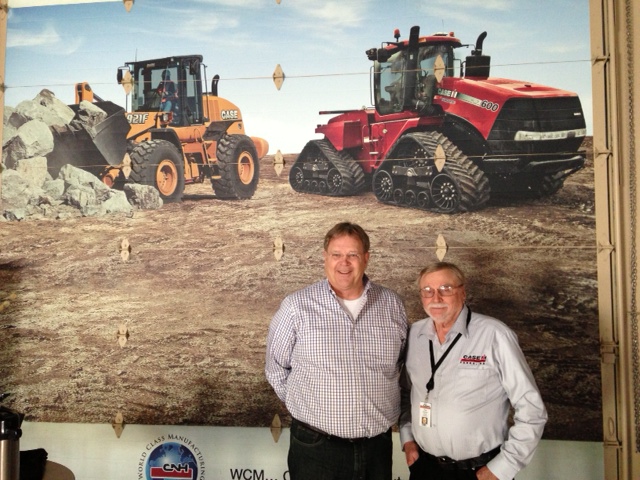
Pat and I returned yesterday from a few days in North Dakota.  Yes, North Dakota!  (or should I say ‘Yaaaaah, Nort Dakoda’?)  It was our first time to visit the state, and the visit allows us to check off ND as the 49th on our list of states visited. (Only Alaska remains for us to experience)  We flew to Fargo on Monday morning, and after lunch at the downtown Rhombus Guys, (the tater-tot hot dish was so-so) we visited the Case-IH tractor factory.  We were warmly greeted and given a tour by Chuck.  He is a retired farmer from the area, and his son is an engineer in the plant.  No pictures were allowed inside, so I cannot share what we saw here… but it was impressive.  One interesting fact Chuck shared was that 60-70% of the new Steiger tractors are built with rubber tracks instead of wheels.

Tour guide Chuck was a pleasant host in our 2-hour visit.

Tour guide Chuck was a pleasant host in our 2-hour visit at the CaseIH plant in Fargo.

Next morning, we drove west to Valley City, ND, to visit the John Deere Seeding Group.  They build air carts and several types of  drills there.  Our goal was to observe the building of our new 350-bushel 1910 air cart and 50-foot 1890 no-till drill.  Dave, the Operations Manager of the plant, was our guide.  We watched every facet of their process, and he answered fully every question.  The tour lasted over 3 hours, and we learned much about the manufacturing processes.  One special part of interest was their ‘rotary molding’ process that makes the big yellow seed tanks.  They were making the 200-bushel size at the time of our visit.  Special plastic powder, that looks a bit like sugar, is dyed yellow, and then about 300 pounds is dumped inside a stainless-steel mold.  The mold is sealed up, and moved inside a 400+ degree heating chamber, and where it rotates on two separate axes.  The heat melts the plastic ‘sugar’, and it coats the walls of the mold.  The rotation evenly distributes the coating over the entire inner surface of the mold.  After a specific time, the mold is moved to a chilling chamber, where it continues to rotate.  Soon, the mold is removed, opened, and the new tank is lifted out by vacuum.  It is placed in a special form-fitting area where cooling air is pumped through the new tank to ‘set’ it.   When the plastic is ‘set’, the familiar leaping deer symbols are attached, the openings are cut, and the tank is placed in a staging area close to the cart assembly line.  All trimmings cut out of the tank are re-cycled to make black plastic parts.

Dave shows Pat the rotary mold machines.  Behind them are the newly-minted yellow tanks in the staging area for the cart assembly line

Dave shows Pat the rotary mold machines. Behind them are the newly-minted yellow tanks in the staging area for the cart assembly line

Here you see the rotary mold of a 200-bushel seed tank.  The heating unit is to the right of the picture, and the cooling unit is behind the tank-shaped mold.  The plastic powder melts inside the 2-axis rotating mold, coating the walls and becoming a new seed tank when cooled.

This is what Dave and Pat are viewing…the rotary mold of a 200-bushel seed tank. The heating unit is to the right of the picture, and the cooling unit is behind the tank-shaped mold. The plastic powder melts inside the 2-axis rotating mold, coating the walls and becoming a new seed tank when cooled.

We observed the carts being asembled, then tested at the end of the line.  They were lifted to waiting delivery semi-trailers on the east side of the building.

Here you see some 550-bushel air carts moving along their assembly line on the east side of the Valley City plant.  In the staging area in the foreground, you see the loading augers or conveyors waiting to be installed.

Here you see some 550-bushel air carts moving along their assembly line on the east side of the Valley City plant. In the staging area in the foreground, you see the loading augers or conveyors waiting to be installed.

We watched robot welders and laser cutters.  An overhead conveyor takes assembled components to the green and black painting areas.  The green paint is a powder-coat that is baked on.  The black is conventional paint, held in a 7000-gallon bathtub, where the parts are immersed.  The painting and baking processes are all automated and timed — with a computer controlling all the movement.  The only human touch is that the green powder is sprayed on by two spacesuit-wearing workers in an enclosed booth.  The paint is electrically charged to cling to the metal parts.  Any overspray is collected and re-used.

Here, large no-till air drill components go into the green paint booth where workers in space suits apply special electrostatic-charged green powder that is subsequently baked on to become that famous green.

Here, large no-till air drill components go into the green paint booth where workers in space suits apply special electrostatic-charged green powder that is subsequently baked on to become that famous green.

Here, some gangs of no-till opener units hang from the overhead conveyor.  These have been cleaned and are ready to enter the black paint-immersion process.

Here, some gangs of no-till opener units hang from the overhead conveyor. These have been cleaned and are ready to enter the black paint-immersion process.

Here you see both green and black components moving from the paint areas to the appropriate positions on the assembly line.

Here you see both green and black components moving from the paint areas to the appropriate positions on the assembly line.

We watched the 3 assembly lines on the west side of the building, with particular interest in the no-till drill line.  The row units are assembled on their rockshafts in a precise jig, and when they return from black paint, they are staged on the assembly line in a particular order to fulfill the requirements of the drill being assembled.  Each drill is different as they pass down the line, and the components are staged in proper order so that each drill is assembled according to the the customer’s order.  It’s kind of like tributaries flowing to a main river.  At the end, some testing occurs, then the drills are lifted to waiting semi-trailers to be delivered to the selling dealer.

I love to visit these factories, to watch the machines come together.  I appreciate the ‘choreography’ and the complex systems  that deliver a finished product to the door.  What precision in management.

After our full-morning John Deere tour, we had lunch at a nice little restaurant in Valley City.  Pat found this by browsing ‘Yelp’ on her iPad.  We were pleasantly surprised with the chef and menu.  Chef Abel was of Mexican descent, and prepared us old family recipes.  We think it was the best Mexican food we ever had!  Abel also gave us his testimony of how he has been blessed to leave his construction job and begin his life’s dream of operating a small, friendly restaurant, where he can serve people the recipes he learned from his mom and grandma.   So, if your travels take you across I-94 to Valley City, ND, stop at “Another Time” restaurant for a great meal.

This is Another Time restaurant in Valley City.  The owner and chef Abel will make you feel welcome, and prepare you an excellent meal.

This is Another Time restaurant in Valley City. The owner and chef –Abel– will make you feel welcome, and prepare you an excellent meal.

We returned to Fargo for the evening.  Fargo is a really neat city, with something over 100,000 residents.  We toured the Plains Art Museum, and drove around to get a feel for what the place is like.  It is home to North Dakota State University.  NDSU is to North Dakota what Purdue is to the state of Indiana. NDSU’s FargoDome was impressive, as was the 1000s of acres of experimental farms to the west of campus.  Fargo claims to be the Silicon Valley of the north.  It was easy to navigate around town.  Towards dark, the fog-like snow hung in the air, coating everything with a thick and beautiful frosting.  One bank’s outdoor nighttime decor caught our eye, the Gate City Bank.  Each tree was covered in blue LED lights, making a spectacular sight in the snowy night.

In downtown Fargo, we viewed a special exhibit of Andy Warhol's art work.  Outside you can see the beautiful frost that clung to trees and bushes all day.

In downtown Fargo’s Plains Art Museum, we viewed a special exhibit of Andy Warhol’s art work. Outside you can see the beautiful frost that clung to trees and bushes all day.

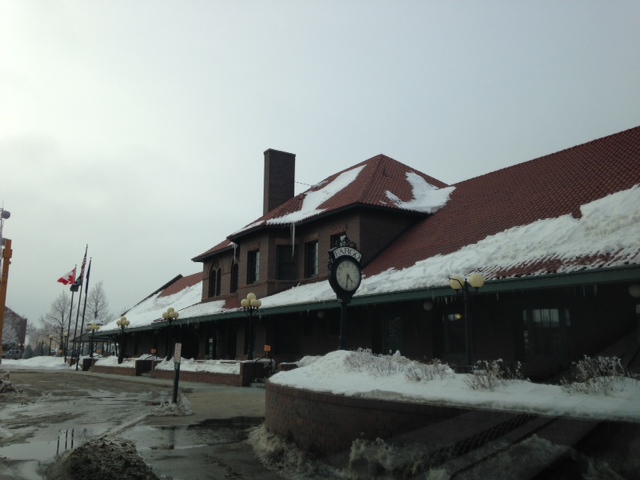
The old train station in downtown Fargo was very impressive.

The old train station in downtown Fargo was very impressive.

The lights at Fargo's Gate City Bank were really beautiful on the snow.

The lights at Fargo’s Gate City Bank were really beautiful on the snow.

We were impressed with North Dakota.  The people were warm and friendly, the countryside was flat and beautiful.  I would like to see it again during the summer.  But these few winter days weren’t bad either…temps in the high 20s during the day, and between 8 to 12F at night.  And the wind was calm, making it all the more pleasant.  Maybe that’s not typical.  We know it snows a lot there, for the hotel parking lot had stacks of snow 12-15 feet tall.  Hopefully, we will see ND again someday.

Here is a typical skyscraper of the prairie.  This one is in Wheatland, North Dakota.  The town's name sparked our interest for obvious reasons.

Here is a typical skyscraper of the prairie. This one is in Wheatland, North Dakota. The town’s name sparked our interest for obvious reasons.

The trip home took a little longer than we expected.  The snowy weather in Chicago on Tuesday, cancelled some flights–compressing travelers into delays.  Our flight Wednesday evening from ORD to EVV was overbooked, so we took the incentives to delay our travel until Thursday morning.  It worked okay for us, and allowed two other people to get home as they needed.  Our flight yesterday was pleasant.

Back in Indiana today, we awoke to see the ground covered in white.  It will probably be gone by dark, but it was nice to see it today.  We saw lots of white in Fargo!  Big piles of it!  I’m catching up the office work, and Grandma Pat is caring for little Ella today. It’s a happy day.  John and Brandon are waxing the 4730 sprayer.

In other news, the grain bins at the Burke farm have been sold, so I have removed the ‘For Sale’ tab from this website.  Thank you to the buyer from Milan, Indiana.

I realize this is a long post, but we had a great visit ‘up nort’.
Posted in Farm Days, News | Tagged , , , , , , , , , , | 1 Comment

Here it comes again

Thursday, February 21, 2013

It started out as sleet about 330pm, and moved on to become a full-fledged snowfall by 5pm.  Pat tells me the roads were slick as she came home from work.  We postponed tonight’s small group Bible study until next Thursday.  Local schools let out early, and tonight’s local basketball games have been reset to Friday night.  This looks and feels like ‘basketball tourney time’ in Indiana.  (The girls touney is at semi-state level, and the boys tourney begins next week)    This will be a good night for staying in!

Pat arrived here after work, and said the roads are slick.

Pat arrived here after work, and said the roads are slick.

The place turned white from 330 to 5 pm, and it's still coming down.  It'll be nice to be home, just looking out at all this.

The place turned white from 330 to 5 pm, and it’s still coming down after 6 pm.  It’ll be nice to be home, if only to be looking out at all this.

John and I have been discussing field operations, and we think that the next day when we have dry enough soil conditions, we will begin to apply anyhdrous ammonia, more commonly known as NH3– which is our corn crop’s nitrogen source.  Not sure when that will occur, but he has the machine prepared.  I wrote the application prescriptions, and those are now installed into GS3 system in the 9360R tractor.  We’re ready to hook up an ammonia tank-wagon and begin.  Because of the difficulties we experienced with the metering system last spring, we will begin cautiously– initially using a flat-rate.  Once we are convinced that the metering-control system is working properly, we will move on to the variable-rate application.  We are very hopeful that the things John learned last spring, along with the improvements made by Capstan, will allow us to apply NH3 with more confidence in its accuracy.

I showed Brandon Knight (Ross’ grandson, and ag student at Vincennes University) today a little bit about how I set up the NH3 prescriptions.   There will be dozens more to create for planting soybeans.  I do not yet have enough information from the seed dealer to write them.  But once the dealer reports to us the seeds/pound for each variety, I will begin to write the planting prescriptions.  This year, I hope to include Brandon in the process, so that he can learn this vital task.  It is never too soon to have another trained person who can perform what is needed.

Going home now…

Posted in Farm Days, News | Tagged , , , , , , | Leave a comment

Smoothing the ridges

Monday, February 18, 2013

This morning I had a rare privilege to operate a tractor in the field in February.  It was dry enough for me to use the JD 9330 tractor with the field cultivator in the field at the Waldo farm… the one that had the drainage tile installed back in early December.  After the tile is installed, rain causes the trenches to ‘settle’ and leave a rut with a hump alongside.  This operation today was to smooth the humps and fill the ruts.  It was working quite well this morning, and that was sort of a bonus, for field work in February is very rare.  Usually it is too frozen or too muddy.

I ran the tractor at a half-width for each pass, thereby giving the soil a twice-over operation, and leaving the field surface very level.  The action of the tines of the field cultivator pulls down the humps, and fills in the settled trenches.   Whoever brings the next operation over this field will be pleased, for they won’t encounter these giant ‘speed bumps’.  The next pass over this field will likely be the ammonia applicator, or the corn planter, or perhaps the sprayer.  The weather and soil conditions will tell us what comes next.

I ran the tractor and field cultivator in such a way as to overlap about half-width.  In this way, the field was worked twice.  It is rare to find soil conditions this good in February.  Working the soil twice left the surface very level.  No 'speed bumps' now!

I ran the tractor and field cultivator in such a way as to overlap about half-width. In this way, the field was worked twice. It is rare to find soil conditions this good in February. Working the soil twice left the surface very level. No ‘speed bumps’ now!  Can you see the target trenches at an angle across the tractor’s path?

Looking back, it was satisfying to smooth down those ruts and ridges.

Looking back, it was satisfying to smooth down those ruts and ridges.

I assisted John in bringing home the ammonia applicator from storage at the Huey farm.  John needs to replace some of the wiring harnesses that were damaged during the winter by chewing mice.  He has it in the shop this afternoon to begin that task.

While going to the Huey farm this afternoon, I could not help but notice the wheat crop planted there.  It captured my attention with the quality of its appearance.  The wheat there was planted after last fall’s corn harvest, and it got a great start.  This is some of the best looking wheat I’ve ever seen (for February).

This is the view of the wheat crop at the Huey farm.  It grabbed my attention as I drove by.  Lookin' good for February wheat!

This is the view of the wheat crop at the Huey farm. It grabbed my attention as I drove by.  Lookin’ good for February wheat!

Tomorrow is a big day, this farmer turns 60!  Another milestone reached.

Posted in Farm Days, News | Tagged , , , , , , | Leave a comment

NFMS

Friday, February 15, 2013

Victor Pichot and I returned yesterday from the National Farm Machinery Show (NFMS) at Louisville, Kentucky.  We spent about a day and a half touring the exhibits at the Exposition Center.  The weather on the drive down on Wednesday delayed our arrival, because of the snowfall.  But even with the snowfall, the building was crowded.  We stayed Wednesday until the exhibits closed for the day.  We returned to complete our visit on Thursday morning.  We did not spend much time on the large, major exhibitors, but rather Victor preferred to concentrate on the small booths, showing his specific interest in row units for fertiliztion and planting.  He purchased a ‘Redball’ monitor for a 12-row planter.  He interviewed extensively the vendor of the “Clipper” grain cleaner.  He inquired with every distributor of replacement parts for tractors, combines, and tillage equipment.   He wanted to establish connections that would enhance his implement business back in France.  He told me on our arrival that he wanted to ‘see everything’, and I think we did!

Both of us found the extensive exhibits to be valuable to disover the specifics of new machines and new features on existing machines.  I found some new information technology at John Deere that will be worth further investigation at our dealer.

As we traveled on Wednesday morning, we encountered heavy snow in Dubois County.  We drove though a steady snowfall all the way to the show site in Louisville.

As we traveled on Wednesday morning, we encountered heavy snow in Dubois County. We drove though a steady snowfall all the way to the show site in Louisville.  But the roads for the travel home on Thursday afternoon were clear and dry.

There was a big crowd around this S690 John Deere combine

There was a big crowd around this S690 John Deere combine

The Super-Duty Ford pickups are now offered in a "Platinum" model.  Here is the interior of a new F-350 Platinum.

The Super-Duty Ford pickups are now offered in a “Platinum” model. Here is the interior of a new F-350 Platinum.

On Thursday, Victor was impressed with the number of pickups in the parking lot.  It was apparent that most farmers arrived in their pickup.

On Thursday, Victor was impressed with the number of pickups in the parking lot. It was apparent that most farmers arrived in their pickup.

Victor made many valuable contacts

Victor made many valuable contacts

We toured the pulling tractors on display in Broadbent Arena.

We viewed up-close the pulling tractors on display in Broadbent Arena.

Back here on the farm today, John and Brandon are polishing the aluminum and chrome on the Peterbilt.  It’s going to be very shiny!  Vanna and the Vision will probably be next in line.  I’m catching up the bookkeeping, and writing this week’s paychecks.  Many of the annual payments on our farm machinery will be due on February 28.  I will prepare to make them online today, for payment on their due date.

Today is also little Ella’s 6-month birthday!  She is growing and changing…  the tip of her first tooth is visible.

Posted in Farm Days, News | Tagged , , , , , | Leave a comment